By Kira Sjöberg, AI coach and entrepreneur
In brief
The Tekoälytalkoot training project aims to coach employees into active AI users without heavy IT processes. Funded by JOTPA, Finland’s Service Centre for Continuous Learning and Employment, it trains 3,600 professionals in using AI.
The training emphasises practice — participants identify areas for improvement in their own work and use AI to address them, taking ethical and data protection questions into account.
The diversity of the assignments shows generative AI adapting to very different needs. Participants learn to recognise their own biases and develop critical thinking about AI.
The project anticipates a shift in Finnish management culture towards a “citizen developer” model, in which employees are given the freedom to use AI tools independently to innovate.
Using AI can have significant economic potential — in a hypothetical example, the annual value of innovations in a 100-person organisation could be as much as €1.5 million.

How to build new rules for working life – freedom to develop, permission to experiment
How would it sound if, in your workplace, everyone could freely use AI to develop and improve their own work without heavy IT processes or constant management approval? Imagine AI as a colleague you can bounce ideas off, solve challenges with, and use to find entirely new solutions. That is exactly the future being built right now in the Tekoälytalkoot training project. The programme sets out to turn employees into active developers of the company’s business with the help of AI, and lays the groundwork for a very different kind of working life.
The ongoing Tekoälytalkoot training project is funded by JOTPA (the Service Centre for Continuous Learning and Employment), and trains 3,600 professionals in using AI to make work more effective across five different occupational areas. It is comprehensive training that offers participants not only theory but practical exercises, in which AI is brought into their own daily work and tasks as a sparring partner.
One of the courses is “AI tools for making work more effective”, and what matters in it is practicality: the participant identifies a problem or area for improvement in their own work and uses a large language model to solve or improve it. That process is not solely technical; it also involves considering ethics, data protection, copyright, and bias, in order to reach a usable and equitable result.
Assignments are like people: each one its own
In a little over three months, the project has produced more than 300 assignments. One of the most interesting observations is that not a single assignment has been the same as another. That diversity says something about how differently people think, how their needs and approaches differ, and how generative AI bends to many purposes, acting as a kind of extension of the person. In practice every participant brings their own perspective to using AI, which creates an enormous number of different use cases for how AI tools can make everyday work more effective and improve the work itself.
That diversity is also an excellent demonstration of how AI literacy is best improved through practice and doing. As participants learn to work iteratively with a language model, they also learn to recognise their own biases and reflect on their own thinking. That not only improves their ability to use AI but develops their critical thinking about it and their skills in handling information — which is the heart of the course.
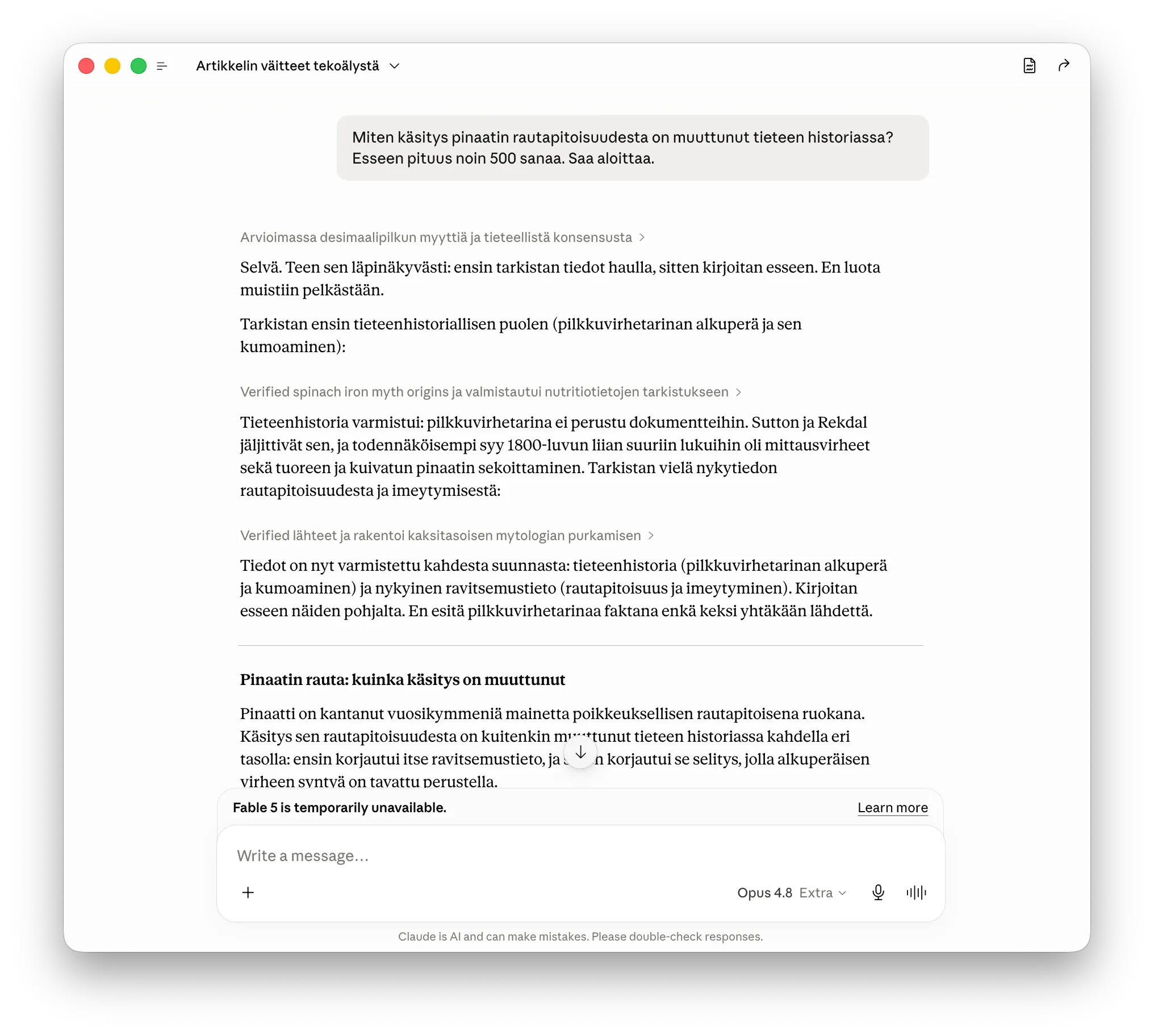
AI, and generative AI and language models in particular, are in practice a mirror of the user. That idea has to be clear, so people understand the input-output rule when using different AI tools. At the same time, by building filters and rules, widespread use and training of language models will (hopefully) allow models to be built in a more equitable direction. One example is an article published in the Finnish science magazine Tiede in 2024, describing an experiment in which (supervised) language models helped change conspiracy theorists’ opinions when people were asked to prompt a language model for information and the model was steered to answer objectively and tirelessly. That illustrates the positive potential of these technologies.
Is a change in Finnish management culture coming?
The Tekoälytalkoot training makes it clear that a cultural change in Finnish management is inevitable. The companies that dare to make that change will be the winners. This is not just about adopting new tools but a comprehensive change in how management is understood and practised.
Traditional hierarchical management models, in which AI tools are used only on instructions from above, no longer work in AI’s fast-moving world. What is needed instead is a new way of thinking, which can be described as “citizen developer” thinking. That means giving the people in an organisation the freedom and the opportunity to use AI tools independently to improve their work and to innovate. That process of change is likely to be challenging in a safety-seeking country like Finland.
A concrete example of the citizen developer model’s value potential (a hypothetical calculation)
The following example illustrates the possible economic value and potential of the citizen developer model, which practical training such as Tekoälytalkoot can help achieve. Although these are not results drawn directly from the training, the model gives companies a concrete benchmark if they want to head down the citizen developer road. The figures below are entirely hypothetical, as a basis for thinking about the matter:
1,000 ideas a year, of which:
1 idea (0.1%) is a “unicorn”, with proposed added value of €500,000 a year.
99 ideas (9.9%) improve work in a scalable way, with a combined value of €990,000 a year (99 ideas × €10,000 per idea).
450 ideas (45%) improve individual-level motivation and efficiency, with an estimated value of €90,000 a year (450 ideas × a hypothetical €200).
The remaining 450 ideas (45%) produce no direct economic benefit, but offer valuable learning from what works and what doesn’t — and at least do no harm.
Although a large share of ideas produce no direct financial benefit, the better wellbeing and motivation they generate among employees probably produce significant indirect benefit. An organisation does of course need some kind of framework behind the model for ethical and secure AI use, but even that should not be too tight — rather a whole that is open to iteration within a change-oriented process.
Tekoälytalkoot’s practical courses thus offer not only the necessary practical skills for using AI but also open up varied use scenarios and underline the need for management to develop towards a model that gives employees more freedom and more opportunity to innovate (citizen developer thinking). In future, practical training of this kind will be key to strengthening organisations’ competitiveness, improving AI literacy, and building a new, enabling kind of management.
An AI tool — in this case a large language model — is not just an instrument but a catalyst for new ways of working and thinking. That does of course require a mindset change from everyone, which is not necessarily possible or at least not easy. High agency in people has recently been raised as a skill or quality for the future, and there is surely a need for coaching in organisations to achieve it — the Kaizen method familiar from Lean has been considered one workable route.
Through the “AI tools for making work more effective” course, participants become active users of AI who challenge their own thinking and approach problems in new ways. That not only improves AI literacy but lays the groundwork for a new kind of working life in which everyone has the chance to be an active part of development — and creates for Finland a new route to innovation-led activity in business and in society more widely.
About the writer
Kira Sjöberg (LinkedIn) is one of the three founders of GOODIN. GOODIN advances organisational development by enabling data and AI through human-centred strategies. Kira’s particular expertise is in questions of how to use generative AI, building a data-driven organisational culture, developing AI literacy, and human–AI collaboration.
Enjoyed this article? Subscribe to get notified about new Tekoälyfoorumi articles straight to your inbox. We’d also hugely appreciate it if you left us a review on Google. Thank you. 💙