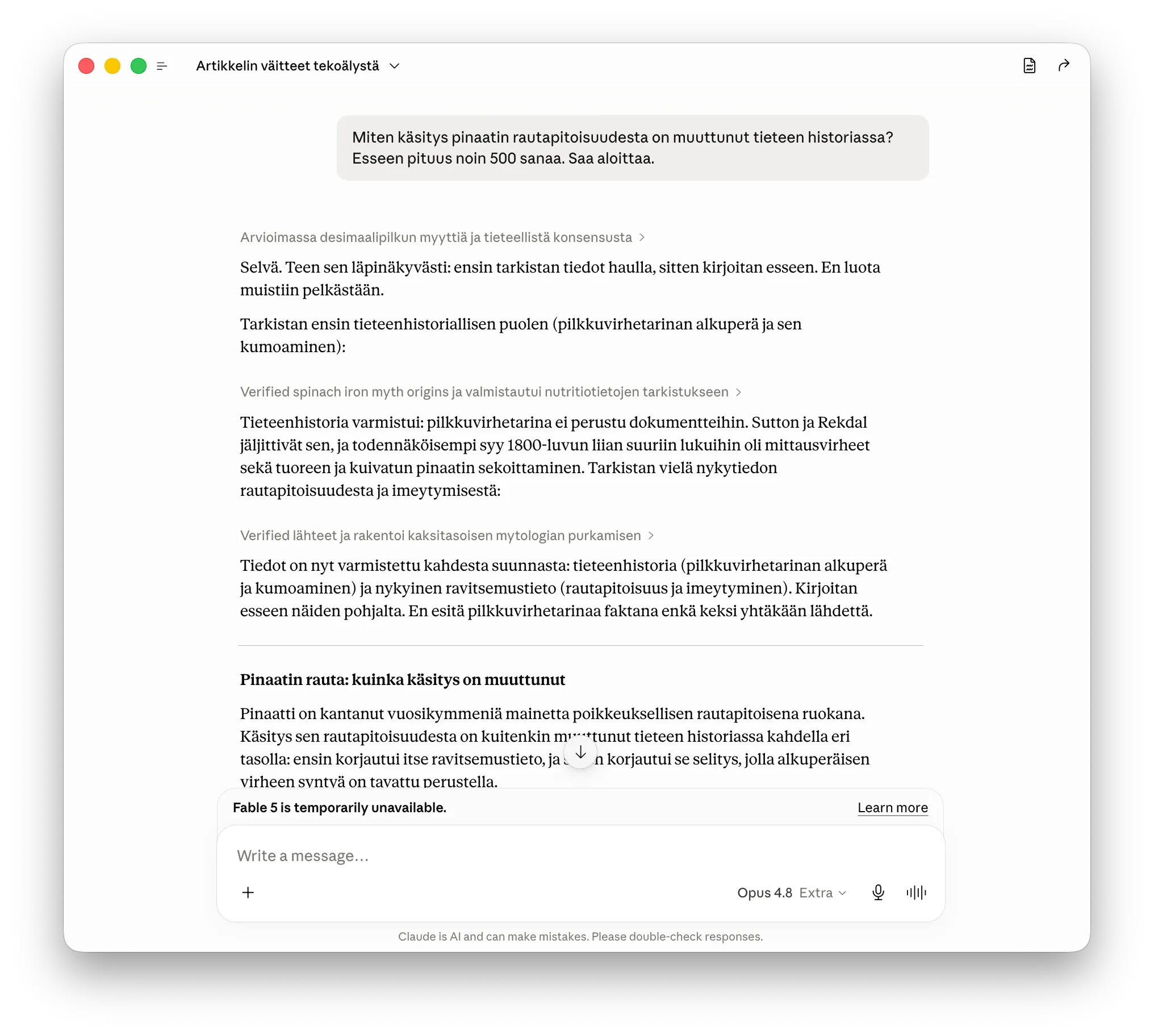
Not so long ago, we often stressed in our training sessions that AI does not understand things, it merely predicts the next word or sentence.
“Even though it looks like the AI is trying to solve the problem, really it’s just an advanced word-guessing machine!”
That felt responsible in a way. We wanted to emphasise AI’s limitations and the fact that it isn’t really thinking about anything.
That view of AI is outdated. We no longer use it.
As things stand, new AI models do far more than predict words or sentences. They can:
Break complex problems into clear steps
Evaluate and improve their own answers
Maintain coherence even across long texts
Balance several goals at once
AI does not understand things the way humans understand them. Nor does AI still think the way a human thinks. But modern AI processes information in a way that resembles thinking far more than mere statistical prediction does.
A practical example: starting a company
Imagine a simple task given to an AI: “Write a step-by-step plan for starting a small business.”
An older AI model might answer like this:
“Step 1: Start the business. Step 2: Make a plan. Step 3: Secure funding…”
That is purely statistical chaining of words, based on the AI’s training material.
A modern AI approaches the task differently. It identifies the key stages of starting a business (market research, legal requirements, funding, and practical steps, for example) and works through each stage coherently. The result comes close to a carefully considered business plan.
A practical example: law and social media terms of use
If you asked an AI for social media terms of use, older models would most likely offer generic, familiar legal phrases:
“The user uses the service at their own risk. The company reserves the right to terminate access at any time…”
Those words appear in the AI’s training material, and so they statistically tend to follow one another.
A modern AI model, by contrast, would understand the whole from several angles (user rights, content ownership, limitations of liability) and would be able to think about the problem more deeply. It might recognise that long terms of use go unread, and would try to solve that problem by drafting a summary of each section.
For me this has been a decisive observation: modern AI systems genuinely try to solve the user’s problems. What’s more, they do it using means familiar to humans: internal monologue, testing, criticism, and new drafts.
What made that change possible?
Three important technological steps lie behind the shift:
Scale: larger AI models enabled new capabilities that were not explicitly programmed.
Architecture: transformer structures and attention mechanisms make text generation more coherent and more sensitive to context.
Training methods: reinforcement learning from human feedback (RLHF) steers models towards answers people find useful.
Our understanding of AI has changed – how should we talk about it?
It is no longer useful to see today’s AI models as mere word-predicting machines. They may not understand the world the way people do, but they simulate reasoning and planning in ways that clearly go beyond predicting words.
It is hard to capture this development in a single term. “Probability-based simulation” perhaps comes closest.
The words and mental models we use matter a great deal for how we make use of AI.
Anthropomorphising AI can lead us astray. On the other hand, describing AI as merely a “word machine” ignores how much machine “thinking” has developed.
We need new analogies and more precise mental models that better describe how AI actually works. If you come up with a better description, tell us!
Enjoyed this article? Subscribe to get notified about new Tekoälyfoorumi articles straight to your inbox. We’d also hugely appreciate it if you left us a review on Google. Thank you. 💙