By Kimmo Rousku

This year I’m marking 40 years in the field — 40 years since I started speaking, writing, and teaching, first about data processing, then about information technology generally, then about information security, ICT, digitalisation, and now about newer technologies such as AI. For the past 30 years I have worked in the Finnish central government in interesting specialist and management roles. At present I am responsible for leading the VAHTI network at the Digital and Population Data Services Agency.
AI crept into our devices, but now it is going everywhere
Every internet user has been using AI, machine learning, or similar technologies, directly or indirectly, since as far back as the 1990s. Spam filters are one example, as are the recommendation features in streaming and e-commerce services. Most people have surely tried Apple’s Siri, Google Assistant, or Microsoft’s Cortana at some point — the talking bots of the first generation of smart devices. One of the finest applications is GPS navigation; I use Google Maps a great deal myself. Thanks to “AI”, how rarely it is off by even a few minutes when estimating arrival at a destination far away, and how well it suggests a faster route when something unexpected happens on the default one.
Every connected device will get AI – the way things once got electricity
Everything changed in autumn 2022, when OpenAI released the first widely distributed version of ChatGPT. What has astonished me most is that the pace of AI development has not merely increased, it has increased faster than expected. At the same time, a growing market has brought with it an enormous number of billion-dollar companies and smaller startups. If the internet has become a precondition for digital services and devices, an AI connection will in future be a central part of that same whole.
AI is a brilliant opportunity – unfortunately for criminals too
As we know, every technological opportunity has its flip side: the threats and risks the new technology brings. AI is no exception. I am still surprised to receive very badly worded scam messages from online criminals in my personal email. They just can’t do it.
What worries me most, though, are “phone scammers” equipped with talking AI and deepfaked video characters, which will be harder and harder to tell from the real thing. For that reason I recommend that every family agree a code word that can be used to verify a person’s authenticity in situations where a relative’s behaviour starts to feel strange (for example, “Dad, I need €300 right now for a new phone”).
On the other hand, I have sent numerous websites and phishing messages to AI-Kimmo, the ChatGPT digital twin living on my personal phone, and it has been excellent at identifying and flagging what’s wrong with a message. Below is an example of a digital scam campaign I spotted on Facebook, run in the name of the hardware chain Bauhaus, and how AI-Kimmo recognises and warns about it.
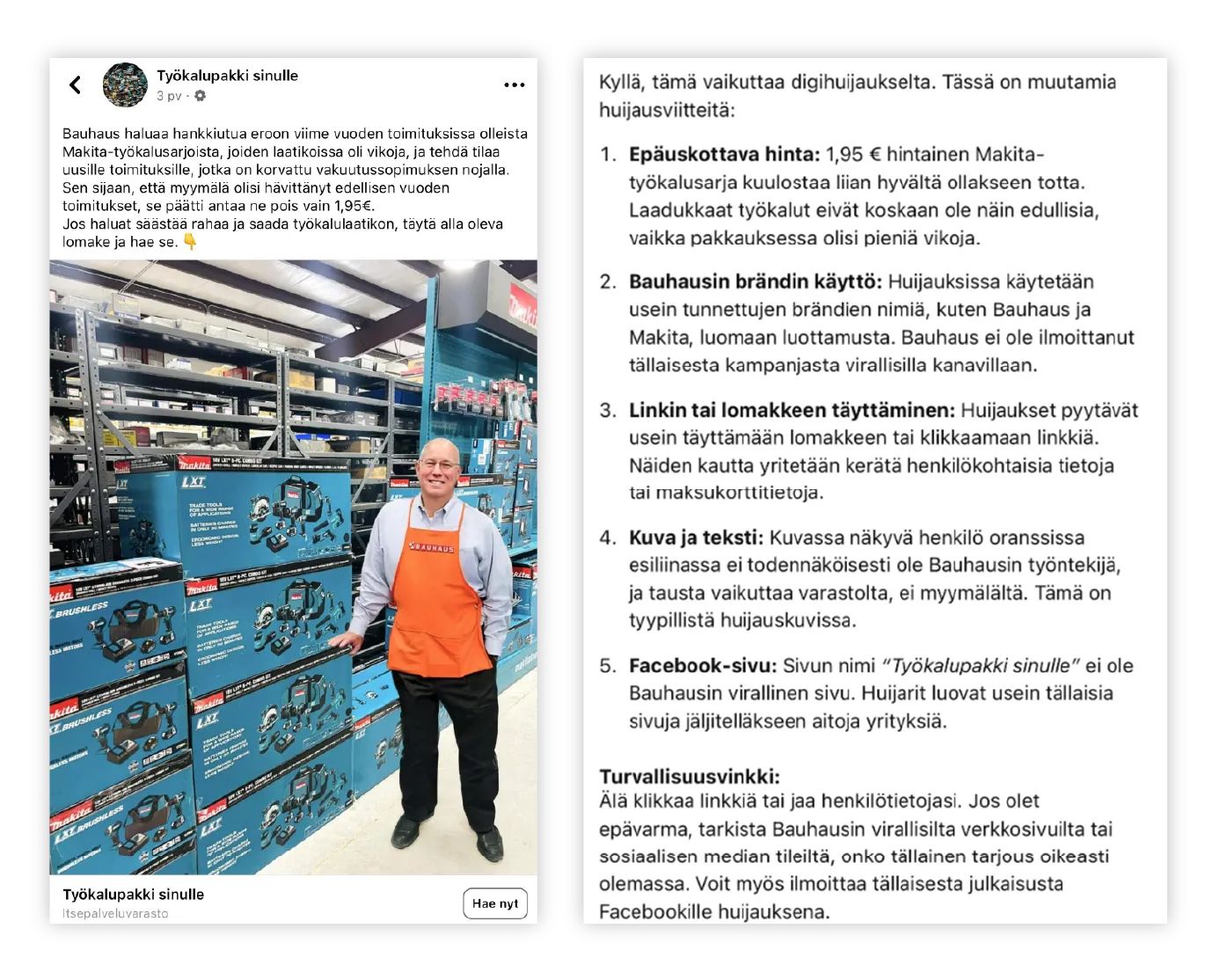
This kind of capability needs to be built into devices and services.
AI became a research assistant that lets anyone solve demanding tasks
Early this year, all the main makers of large language models brought increasingly advanced versions to market, capable of deep analysis. I have tested the following, for example: xAI Grok 3 Beta DeepSearch and Think, ChatGPT 4.5 Deep Research, and Google Gemini Deep Research. With these I have been able to study and work things out at a level that would otherwise have been very time-consuming or hard to do, including entirely outside my own expertise. It is worth remembering that these are only the first generation of this advanced technology. What is in store over the next two and a half years?
Remember: AI still makes mistakes
For many tasks, AI offers an enormous efficiency gain compared with a human. When verified training data is used and you are otherwise careful, hallucinations can be prevented. In every training session I give, I show examples of AI’s mistakes: wrongly produced information, images, and deepfaked video.
In music, spotting the mistakes is a little harder. When you have several AI services available, you can use them to cross-check, especially where critical information is concerned. Hallucination is an unfortunate burden on AI that significantly reduces its efficiency and reliability in certain tasks. Then again, we humans make our own errors too.
AI is only part of a larger, critical development
Although the development of AI services is on show everywhere right now, it is worth remembering that other technologies are developing at the same time. The metaverse is arriving as a new remote work and entertainment environment; quantum computers bring the possibility of solving (and, in the case of encryption, causing) significant problems for humanity; and humanoid robots will make everyday life easier while irreversibly changing our role as working people. 6G networks will provide the super-fast, low-latency connections needed to make use of these new technologies. Space will become part of our cyberspace.
Humanoid robots – humanity’s greatest global threat and opportunity
One significant area of research is (humanoid) robots. Alongside the traditional industrial robots already in use, an even larger market will eventually form around service robots, which will be used widely in society, in companies, and in homes.
On 18 March 2025, NVIDIA released GR00T, a significant step forward in humanoid robot development. The model is designed for developing the reasoning and skill functions of general-purpose humanoid robots. It uses multimodal input, such as language and images, to carry out manipulation tasks in varied environments. You can read more here: NVIDIA Announces Project GR00T Foundation Model for Humanoid Robots and Major Isaac Robotics Platform Update | NVIDIA Newsroom.
Having watched technology develop from a front-row seat for 40 years, I’ll venture that over the next 10 years our environment will change by roughly as much as it has in the last 40 combined. Everything we do today may feel, by 2035, a little like the age of steam. Add another five years and let’s see where we are in 2040.
How do you see the future? Join the discussion via the writer’s poll: LinkedIn: https://www.linkedin.com/feed/update/urn:li:activity:7309684721771339779/ · X: https://x.com/kimmorousku/status/1903921405625868432
About the writer
In his own time, Kimmo Rousku serves as vice chair of the board of the Finnish Information Security Association, as a non-fiction author, and as a lecturer. Feedback: kimmo.rousku@tietoturva.fi — and do connect: https://www.linkedin.com/in/kimmorousku
Enjoyed this article? Subscribe to get notified about new Tekoälyfoorumi articles straight to your inbox. We’d also hugely appreciate it if you left us a review on Google. Thank you. 💙